Property Restoration After Fire Damage: A 2026 Guide
Table of Contents
- Immediate Steps After a House Fire: What to Do First
- The Fire Damage Restoration Process Timeline Explained
- How to Clean Soot From Walls After Fire
- Making an Insurance Claim for Fire Damage to Property
- Health and Safety Risks in a Fire-Damaged Property
- Contents Restoration and Debris Clearance: What Can Be Saved
- DIY vs Professional Fire Damage Restoration
- Conclusion
- Frequently Asked Questions
Last Updated: September 10, 2026
Immediate Steps After a House Fire: What to Do First
First, confirm everyone is safe and call 999 if anyone is injured or the fire is still burning. Once the fire service declares the property safe, your priority is limiting further damage and documenting everything for your insurer.
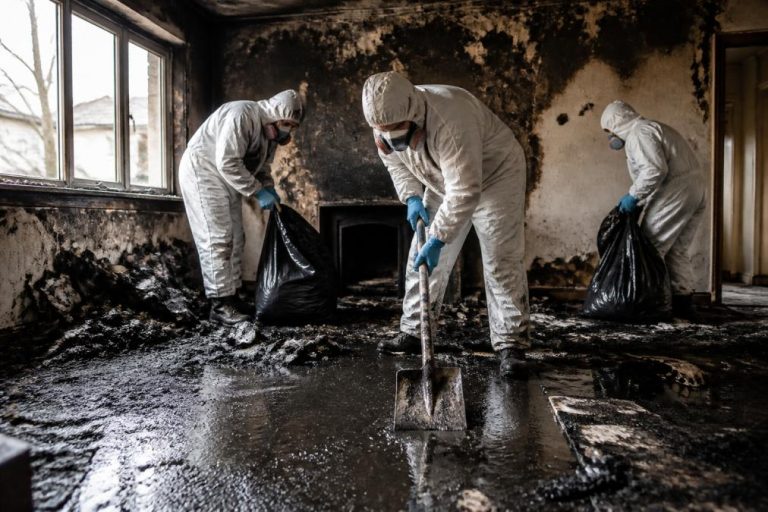
Property restoration after fire damage begins long before a cleaning team arrives: the first few hours shape how much can be saved.
Households that act calmly in the first 48 hours often recover faster, financially and emotionally.
Here is the sequence that matters:
- Wait for clearance. Never re-enter until the fire service confirms it is safe. Structural collapse and hidden hotspots are real risks.
- Contact your insurer. Report the incident and ask what they need before anything is moved or cleaned.
- Photograph everything. Wide shots of each room, then close-ups of damaged items. This evidence underpins your claim.
- Ventilate if safe. Open windows briefly to reduce smoke saturation, but only where the fire service has approved access.
- Do not attempt to clean soot yourself. Soot is acidic and smears deeper into surfaces when wiped incorrectly.
Never use a domestic vacuum on soot. Standard vacuums push fine particles back into the air and can spread contamination through the whole property, including areas the fire never touched.
The Fire Damage Restoration Process Timeline Explained
Most fire damage restoration projects follow a predictable arc: emergency response and assessment, then structural drying, decontamination and reinstatement. A straightforward domestic fire takes several weeks; severe cases run longer.
The fire damage restoration process timeline depends on three variables: how far smoke travelled, how much water the fire service used, and how quickly the insurance claim is approved.
Phase 1: Emergency Response and Damage Assessment
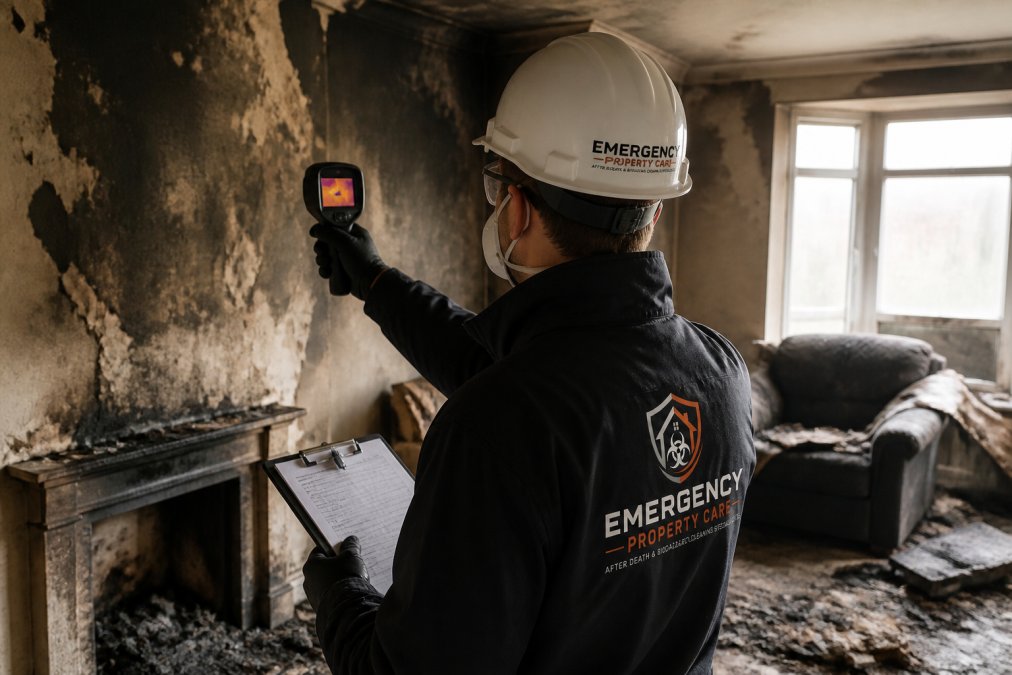
Emergency response covers making the property safe and stopping secondary damage. Technicians board up openings, isolate utilities and begin a full building assessment.
Thermal imaging finds hidden moisture and heat pockets behind walls: an intact-looking wall can hide saturated insulation that will rot within weeks.
The output of this phase is a documented damage assessment that feeds directly into your insurance claim.
Phase 2: Structural Drying, Decontamination and Reinstatement
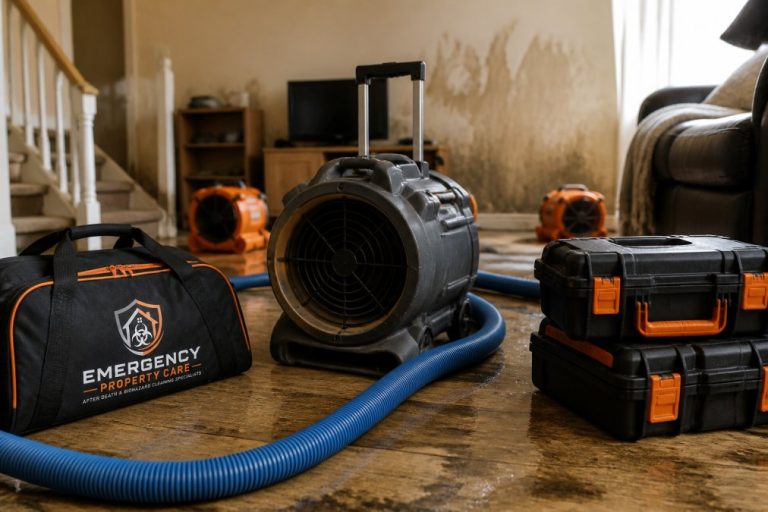
Structural drying removes the water left by firefighting, which often causes more long-term damage than the flames. Specialist equipment runs until moisture readings return to normal. Where firefighting water has spread widely, this overlaps closely with Flood Damage Cleaning and Drying, which addresses the same saturation and drying challenges.
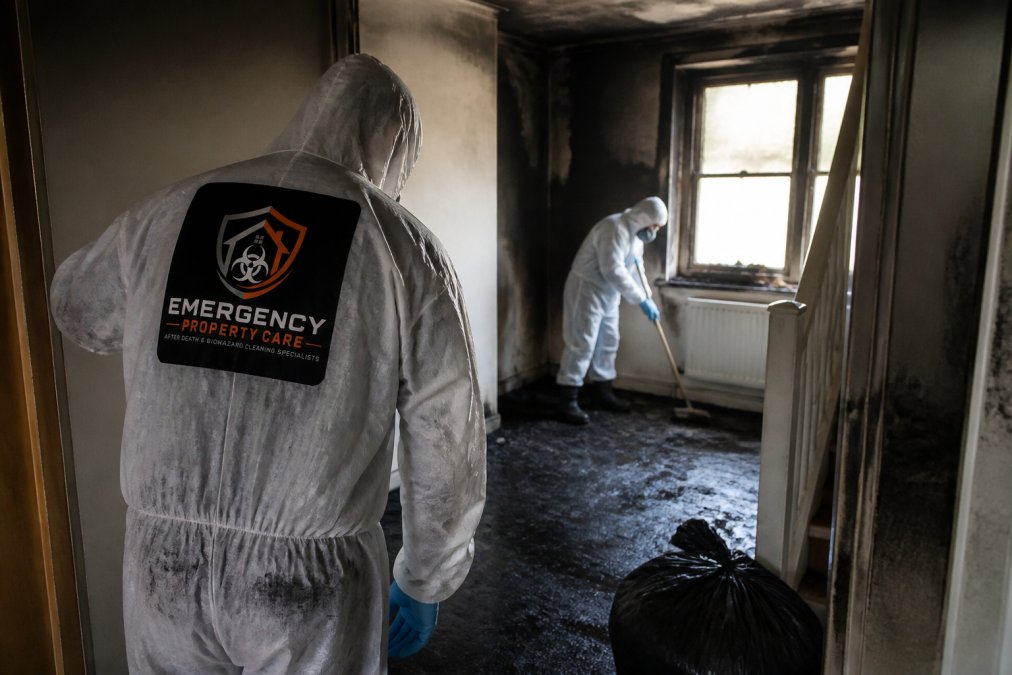
Decontamination follows, addressing soot, smoke residue and odour across every affected surface, including cavities and ductwork.
Reinstatement is the final stage: plastering, decorating and repairs that return the property to its pre-fire state. Corrosion control matters too, because smoke residue accelerates rusting on metal fixtures and wiring.
How to Clean Soot From Walls After Fire
Do not clean soot from walls yourself unless the damage is very light and confined to one area. Soot is oily, acidic and easily spread, and incorrect cleaning can permanently stain plaster and paint.
If you are attempting light surface cleaning while awaiting professional help, the method is specific:
- Wear gloves, an FFP3 mask and eye protection
- Vacuum loose residue only with a HEPA-filter vacuum, never a household one
- Work from the top of the wall downward in small sections
- Use a dry chemical sponge first, then a mild detergent solution
- Change your cleaning cloth frequently; a dirty cloth simply moves soot around
For heavier deposits, cleaning requires specialist products and containment to stop particles migrating into clean rooms: one of the clearest dividing lines between DIY and professional work.
Making an Insurance Claim for Fire Damage to Property
An insurance claim for fire damage to property succeeds or fails on documentation: evidence of what was damaged, what restoration will cost, and confirmation the fire caused it.
Most policies require you to report the incident within 24 to 48 hours; check your policy schedule for the exact window. Late notification can give an insurer grounds to reduce or reject a genuine claim.
Building Your Inventory: A Practical Checklist
Keep a running inventory from day one: every item, its approximate age, condition before the fire, and replacement value. If receipts are lost, bank statements, warranty cards and online order histories serve as proof of purchase.
Use this checklist to structure your inventory:
- Room-by-room sweep: Work through each room methodically, listing contents before moving anything.
- Item details: Record make, model, serial number, age, and original purchase price where known.
- Damage description: Note whether each item is destroyed, smoke-damaged, water-damaged, or salvageable.
- Photographic evidence: Take wide shots of each room, then close-ups of individual damaged items.
- Receipts and proof: Gather receipts, bank statements, or warranty documents for high-value items.
- Professional valuations: For antiques, art, or jewellery, obtain a written valuation if you have one.
Households often underestimate the cumulative value of everyday items: clothing, kitchenware, bedding and toys add up quickly. Insurers expect a comprehensive list, not just big-ticket items.
How Loss Adjusters Work
Loss adjusters are appointed by your insurer to assess the claim. They are not on your side as a solicitor would be, but they are not adversarial either: their job is to verify the loss and recommend a settlement figure.
A restoration partner who provides a clear, itemised damage assessment and documented methodology makes that process faster and less adversarial. TrustedCare works directly with loss adjusters, removing a layer of paperwork.
| Claim Stage | What You Provide | What Happens Next |
|---|---|---|
| Notification | Incident date, cause, policy number | Insurer opens the claim |
| Evidence | Photos, inventory, receipts | Assessor reviews documentation |
| Assessment | Access for inspection | Damage assessment produced |
| Approval | Agreed scope of works | Restoration begins |
| Settlement | Invoices and completion report | Claim closed |
What Insurers Look For
Insurers assess three things: cause, scope and mitigation. They want to see the fire was covered, the damage is consistent with the incident, and you took reasonable steps to prevent further loss.
Reasonable steps include calling a professional restoration company promptly, not throwing away damaged items before assessment, and recording any emergency work. If DIY cleaning worsens the damage, the insurer may reduce the payout.
Ask your insurer whether they have a preferred restoration supplier. Using their approved contractor can speed up approval, but you are not obliged to use them. You have the right to choose your own specialist.
Common Pitfalls to Avoid
- Throwing away items too early: Once an item is in a skip, it cannot be assessed. Wait for the loss adjuster.
- Underinsuring contents: If your contents sum insured is too low, the insurer may apply an average clause and reduce your payout proportionally.
- Missing the notification window: Report the fire as soon as possible, even if you are still in shock.
- Not documenting emergency work: Keep receipts for boarding up, drying equipment, or temporary accommodation.
Health and Safety Risks in a Fire-Damaged Property
Fire-damaged properties carry health and safety risks that outlast the flames. Smoke contains volatile organic compounds, fine particulates and, in older buildings, asbestos fibres from disturbed materials.
The main risks are:
- Respiratory damage from inhaling soot particles and VOCs
- Structural instability from fire-weakened beams, floors and walls
- Electrical hazards from water-damaged wiring and corroded fittings
- Asbestos exposure in properties built or refurbished before the year 2000
Long-Term Air Quality and Hidden Toxicity
Air purification and negative air pressure units are standard on professional jobs because they capture particles that would otherwise settle again. Long-term air quality is often overlooked: a property can look and smell clean while contamination remains in soft furnishings and ductwork.
VOCs are released not just by the fire but by synthetic materials in modern homes: foam insulation, carpets, plastics and electronics. They can off-gas for weeks after visible damage is gone, and some, such as formaldehyde and benzene, are respiratory irritants and long-term carcinogens.
Households often move back in too early because the smell has faded, but odour is not a reliable indicator of safety. Professional restoration should include post-clean air quality testing, using particle counters and VOC monitors, to confirm contamination has returned to baseline.
If you can still smell smoke after cleaning, the decontamination is incomplete. Do not rely on air fresheners or ozone generators to mask odours; they do not remove the source and can create harmful by-products.
The Psychological Impact of Fire Trauma
Losing a home to fire is traumatic, and the emotional toll is often underestimated because the focus is on physical repairs. Anxiety, sleep disturbance, flashbacks and a sense of loss are common in the months after a fire.
Children and older adults are particularly vulnerable. Children may regress, become clingy, or have nightmares. Older adults may grieve the loss of a lifetime of possessions and the familiarity of their home.
Practical steps that help:
- Acknowledge the loss: It is normal to feel overwhelmed. Give yourself permission to grieve.
- Maintain routines: As soon as it is safe, re-establish daily routines for meals, sleep, and school or work.
- Talk about it: Speak with family, friends, or a GP. Your GP can refer you to counselling services if needed.
- Involve children in age-appropriate ways: Let them help choose new items for their room or pack a small bag of salvaged belongings.
- Seek professional support: Organisations such as Cruse Bereavement Support and Mind offer free, confidential help.
Restoration companies that understand trauma make a difference by keeping you informed, giving you a single point of contact and avoiding delays. TrustedCare aims to provide clear advice and a respectful, reliable service from the initial enquiry through to completion.
Fire Safety Compliance for Landlords
Fire safety compliance also matters for landlords, who have legal duties to ensure a property is safe before it is re-let. The government guidance on fire safety in rented homes sets out those responsibilities.
Landlords must ensure:
- Working smoke alarms on every storey
- A carbon monoxide alarm in any room with a solid fuel burning appliance
- Fire doors in flats and houses in multiple occupation (HMOs)
- An annual gas safety check by a Gas Safe registered engineer
- Electrical safety checks every five years
After a fire, a landlord must not re-let until the property is fully decontaminated and structural damage repaired. A documented restoration report from a professional contractor provides evidence of compliance.
Ask for post-clean air quality readings before you move back in. If a contractor cannot provide them, the decontamination stage is probably incomplete.
Protecting Yourself During Cleanup
If you enter the property, wear appropriate personal protective equipment: an FFP3 mask, gloves and eye protection. Do not disturb soot or debris more than necessary, and keep children and pets away until the property is declared safe.
If you experience headaches, dizziness, nausea, or breathing difficulties, leave immediately and seek medical advice. These can be signs of carbon monoxide exposure or VOC inhalation.
Contents Restoration and Debris Clearance: What Can Be Saved
More contents survive a fire than most people expect. Hard surfaces, metals, ceramics and many textiles can be restored through specialist cleaning, while porous items exposed to heavy smoke residue often cannot.
Salvageable assets typically include:
- Solid wood furniture, once cleaned and re-oiled
- Metal and ceramic items, after ultrasonic or hand cleaning
- Clothing and soft furnishings, subject to specialist laundering
- Documents and photographs, where freeze-drying is viable
- Electronics, if assessed promptly before corrosion sets in
Debris clearance runs in parallel: fire-damaged property generates significant waste, some classed as hazardous and requiring licensed disposal. Contents restoration should always be assessed before debris is removed, because once an item is in a skip it is gone.
DIY vs Professional Fire Damage Restoration
DIY fire damage restoration is only realistic for very minor incidents: a small kitchen fire contained to one surface, with no smoke travel and no water damage. Anything beyond that requires professional equipment and often formal decontamination.
The limitations of DIY are practical rather than philosophical:
- Household vacuums cannot contain fine soot particles
- Without thermal imaging, hidden moisture goes undetected
- Odour neutralisation requires more than air fresheners or ozone sprays
- Hazardous materials need licensed handling and disposal
- Insurers may reduce a payout if unqualified work worsens the damage
Professional restoration brings industrial drying equipment, air purification, containment systems and documented protocols, plus the paper trail your insurer needs.
If you are weighing up the two, ask one question: has smoke travelled beyond the room where the fire started? If the answer is yes, this is a professional job.
TrustedCare is best for households and landlords who need a documented, insurer-ready restoration with 24/7 emergency response across England, Scotland and Wales.
Conclusion
A fire damages a property on three fronts at once: heat, smoke and water. Getting the response right in the first 48 hours determines how much of your home comes back.
TrustedCare provides 24/7 emergency response, 365 days a year, with fully insured technicians and specialist expertise in fire-related cleaning and decontamination. We work directly with insurers and loss adjusters nationwide across England, Scotland and Wales.
Get started with TrustedCare and return your property to a safe, usable state with a documented restoration you can hand straight to your insurer.
Frequently Asked Questions
What is salvageable after a fire?
Much depends on the material and how close it sat to the fire. Non-porous items such as metal, glass and ceramics often survive with cleaning. Hard furniture, jewellery and some electronics can usually be restored. Porous items like mattresses, upholstered sofas and cardboard typically absorb smoke odour and are best replaced. A professional contents assessment sorts salvageable assets from items that need disposal, and this inventory also supports your insurance claim.
How long does the fire damage restoration process usually take?
Most properties take several weeks to a few months, depending on the extent of fire, smoke and water damage. The fire damage restoration process timeline starts with emergency board-up and damage assessment, then moves through debris clearance, structural drying, soot removal, decontamination and reinstatement. Minor, contained fires may be finished in two to four weeks. A serious fire affecting structure or electrics can run for three to six months once building work and insurance approval are included.
Who pays for fire damage cleaning?
In most cases your buildings and contents insurance policy covers professional fire damage cleaning, including soot removal, odour neutralisation and specialist drying. If you rent, the landlord’s insurance usually handles the structure while your contents policy covers your belongings. Keep every receipt and avoid arranging work before your insurer or loss adjuster has confirmed cover, because unauthorised spending can be refused. TrustedCare works directly with insurance adjusters to document damage and support your claim.
Is it safe to stay in a property after a fire before professional cleaning?
Usually not. Smoke residue contains fine particulates and volatile organic compounds that irritate lungs, eyes and skin, and soot settles on every surface. Even a small fire can leave hidden toxicity inside wall cavities and ductwork. Structural damage, weakened floors and compromised electrics add further risk. Stay in emergency housing until a qualified assessor confirms the property is safe, and let technicians complete air purification and decontamination before you return.
What is the difference between fire damage and smoke damage restoration?
Fire damage restoration deals with what the flames physically destroyed or weakened: charred timber, cracked masonry, burnt wiring and structural integrity issues. Smoke damage restoration targets what travelled: soot deposits, odour, and chemical residue that settles into walls, soft furnishings and ventilation systems far from the fire itself. Both need addressing together, because a property can look structurally sound yet still smell of smoke and hold harmful particles without proper cleaning protocols and air purification.
Can you get a mortgage on a fire-damaged house?
Yes, but lenders will want evidence the property has been fully reinstated to a safe, habitable standard. Most require a structural survey, proof of completed restoration work and confirmation that any subsidence or roof damage has been resolved. Some lenders decline until reinstatement is finished, so buying a fire-damaged property usually means paying cash or securing a specialist loan first. A documented restoration timeline and building assessment report make the mortgage application far smoother.
How do I know a restoration company is qualified to handle fire damage safely?
Ask for proof of public liability and employers’ liability insurance, relevant trade certifications, and evidence of safe handling of hazardous materials. A reputable provider will complete a written building assessment, use thermal imaging and air quality testing, and follow recognised cleaning protocols. They should also provide a clear scope of works and a documented restoration timeline. TrustedCare is fully insured, operates 24/7 across England, Scotland and Wales, and works directly with insurance adjusters.

TrustedCare Editorial Team publishes UK guidance on specialist cleaning and biohazard remediation, including after-death cleaning, flood restoration and contamination control. Content is written for homeowners, landlords and housing providers seeking clear, practical information.