Who Is Responsible for Cleaning Up After a Fire?
UK Fire-Damage Responsibility Guide
Who Is Responsible for Cleaning Up After a Fire?
Responsibility depends on who owns the property, what caused the fire, the tenancy or lease and the insurance policies covering the building and contents.
Fire, smoke, soot and property-restoration assistance across England, Scotland and Wales
The property owner, landlord or freeholder will usually arrange cleaning and repairs to the building after a fire. Tenants normally deal with their own possessions and contents insurance. However, who ultimately pays depends on the cause, the relevant insurance policies and whether another person may be legally liable.
Do not assume that the landlord, tenant or insurer will automatically cover every cost. Report the incident promptly, preserve evidence and obtain approval before instructing extensive cleaning, disposal or reinstatement work.
Do not enter a fire-damaged property until the fire and rescue service or another responsible professional has confirmed that entry is permitted. Fire can damage floors, ceilings, electrical systems, gas installations and structural components.
Who Is Responsible for Cleaning Up After a Fire? The Short Answer
The person or organisation responsible for arranging the work is not always the person who ultimately pays for it.
| Situation | Who normally arranges the building work? | Possible funding route |
|---|---|---|
| Owner-occupied home | The homeowner or their insurer | Buildings and contents insurance, subject to cover |
| Privately rented home | The landlord normally coordinates structural work | Landlord’s buildings policy; tenant’s contents policy for possessions |
| Tenant may have caused the fire | The landlord or building insurer may still arrange the work | Liability and recovery considered after the cause is investigated |
| Leasehold flat | Freeholder, managing agent or block insurer for common structures | Block buildings policy and individual contents policies |
| Commercial premises | Depends on the lease and insured responsibilities | Building, contents, stock and business-interruption policies |
This table provides general guidance only. The policy wording, tenancy agreement, lease, cause of the fire and the insurer’s decision determine the actual position.
Homeowners, Tenants and Landlords
Owner-occupiers
An owner-occupier normally reports the incident to their buildings and contents insurers and works with the insurer or appointed loss adjuster to arrange:
- emergency board-up and temporary weather protection;
- water extraction following firefighting;
- smoke, soot and odour assessment;
- removal of unsafe or unsalvageable materials;
- structural drying;
- specialist cleaning;
- repairs and reinstatement; and
- contents assessment and restoration.
Buildings insurance generally relates to the structure and fixed parts of the property. Contents insurance normally relates to movable possessions. Exact definitions and exclusions vary between policies.
Tenants
A tenant should:
- notify the landlord or managing agent immediately;
- contact their contents insurer;
- provide access when properly arranged;
- preserve evidence relating to damaged belongings;
- avoid disposing of items until the insurer provides instructions; and
- follow safety restrictions affecting the property.
A tenant is not automatically responsible for all fire-cleaning costs simply because the fire began during their tenancy. Liability depends on the circumstances, the tenancy and whether negligence or another breach can be established.
Where the tenant may have caused the incident, the landlord’s building insurer may still arrange insured repairs and then consider whether recovery from another party is appropriate.
Landlords
The landlord will normally coordinate work affecting the building, fixed services and landlord-owned fixtures. The landlord should:
- notify the buildings insurer;
- arrange emergency security and weather protection where required;
- confirm who can authorise specialist cleaning and removal;
- coordinate access with the tenant;
- address structural, electrical and gas-safety concerns;
- keep the tenant informed about access and habitability; and
- maintain records of inspections, quotations and completed work.
The landlord should not instruct ordinary domestic cleaning where widespread smoke, soot, firefighting water or hazardous fire residue requires specialist assessment.
Confirm what the insurer requires. Unauthorised disposal, strip-out or cleaning can remove evidence, complicate the claim or leave the policyholder responsible for costs the insurer has not approved.
Leasehold Flats and Commercial Properties
Leasehold flats
Responsibility in a block of flats can be divided between:
- the freeholder;
- the managing agent;
- the block buildings insurer;
- the individual leaseholder;
- the occupier or tenant; and
- individual contents insurers.
The lease should explain which parts of the building fall within the leaseholder’s responsibility and which are managed collectively. Smoke and water can travel between flats, communal areas, service risers, ventilation systems and concealed voids, so coordination is important.
Commercial properties
A commercial lease may divide responsibility between the building owner and business tenant. The business may also have separate policies covering:
- stock and equipment;
- fixtures and improvements;
- business interruption;
- loss of rent;
- public liability;
- employers’ liability; and
- alternative trading arrangements.
Review the lease and policies before assuming which party must arrange or fund restoration.
How Insurance Claims Affect Who Pays
Fire is commonly included within buildings and contents insurance, but cover is not automatic in every circumstance. The insurer will consider the cause, policy conditions, exclusions, excesses and the insured parties.
What the insurer may investigate
- how and where the fire started;
- whether the incident falls within the policy’s insured risks;
- whether the property was occupied and used as declared;
- whether policy conditions were followed;
- whether deliberate damage or another exclusion may apply;
- which damage resulted directly from the fire;
- which damage resulted from smoke, soot or firefighting water;
- whether another person may be legally responsible; and
- whether the proposed costs are reasonable and necessary.
Who instructs the cleaning company?
The policyholder usually remains responsible for reporting the loss and obtaining approval. Depending on the insurer and claim:
- the insurer may appoint its own restoration company;
- a loss adjuster may request several quotations;
- the policyholder may be permitted to choose a contractor;
- emergency mitigation may be authorised before the full claim is agreed; or
- the policyholder may need written approval before instructing extensive work.
Ask who is authorised to instruct work, what evidence is required and whether emergency measures can start immediately.
Need a Fire, Smoke or Soot Assessment?
TrustedCare provides specialist fire-damage cleaning and restoration assistance for homeowners, landlords, managing agents and commercial properties.
What to Do During the First 24 Hours After a Fire
The first day should focus on safety, notification, documentation and preventing further damage.
- Follow emergency-service instructions. Do not enter until permission has been given.
- Contact the property owner. Tenants should notify the landlord or managing agent immediately.
- Notify the relevant insurers. Obtain claim references and ask about emergency authorisation.
- Secure the property. Arrange approved board-up or temporary weather protection where required.
- Record the damage. Take photographs and video only where entry is safe and permitted.
- Protect the claim. Do not dispose of damaged items without instructions unless they present an immediate danger.
- Keep receipts. Record emergency accommodation, travel and approved mitigation costs.
- Arrange specialist assessments. Fire residue, water damage, electricity, gas and structural safety may require different specialists.
Gas and electricity
Do not turn electrical or gas equipment back on until it has been assessed by an appropriate professional. If gas is suspected, leave the area and follow the emergency instructions provided by the gas network.
Properties built before 2000
Buildings constructed or refurbished before 2000 may contain asbestos-containing materials. Fire, water and later strip-out work can disturb hidden materials.
Do not cut, break, drill or remove suspect boards, insulation, textured coatings, floor tiles or cement products until the risk has been assessed.
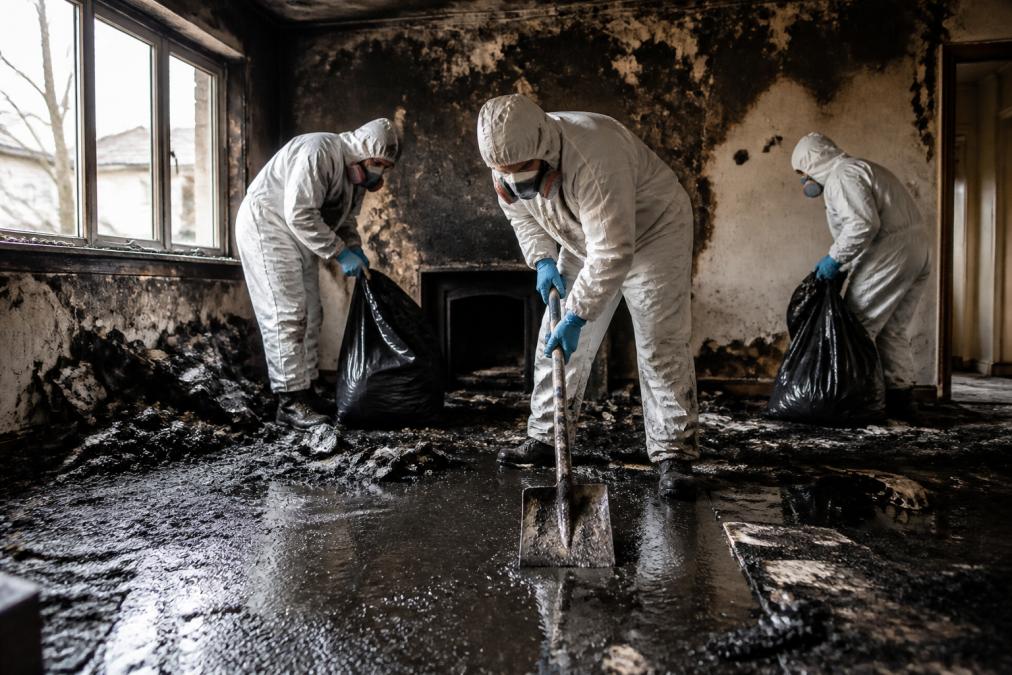
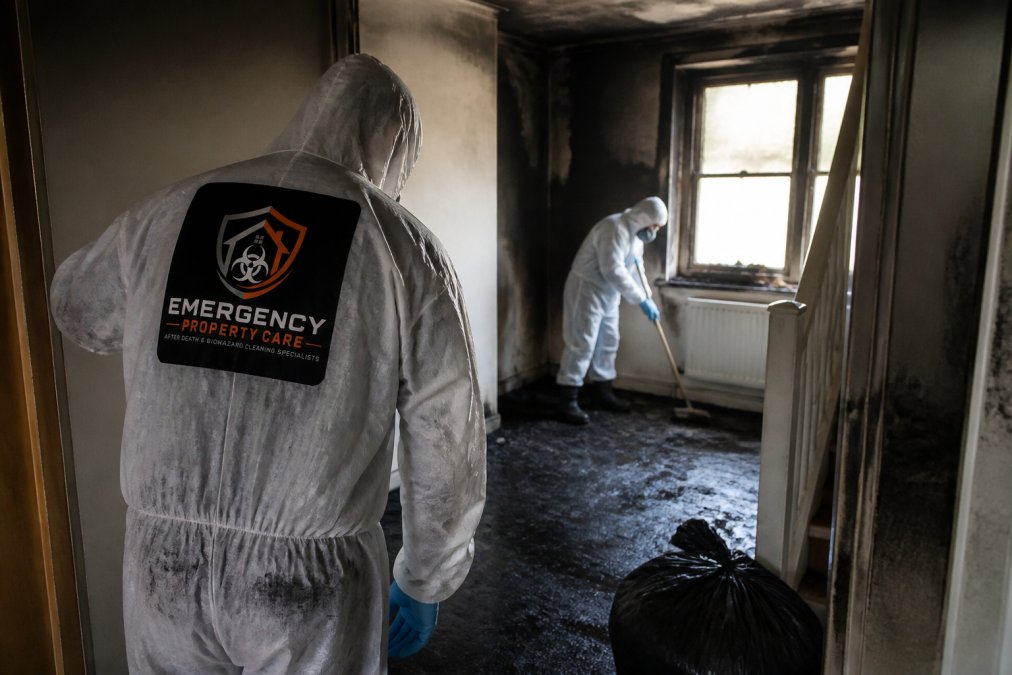
The Fire-Damage Restoration Process
Cleaning and restoration normally involve several distinct stages. The precise order depends on safety, the insurer’s requirements and the condition of the property.
- Scene release and access confirmation: establish that the relevant authority has released the property.
- Make-safe work: secure openings and control immediate hazards.
- Assessment and documentation: record affected rooms, surfaces, contents and suspected smoke pathways.
- Water extraction: remove firefighting or suppression water where appropriate.
- Controlled removal: remove materials that cannot be safely or economically restored.
- Soot and residue cleaning: use methods appropriate to the material and residue.
- Smoke-odour treatment: address the source after contaminated residue has been removed.
- Structural drying: monitor moisture in floors, walls, timber and concealed areas.
- Inspection: check completed cleaning against the agreed scope.
- Reinstatement: repair and redecorate after cleaning and drying are complete.
For more detail, read TrustedCare’s property restoration after fire damage guide.
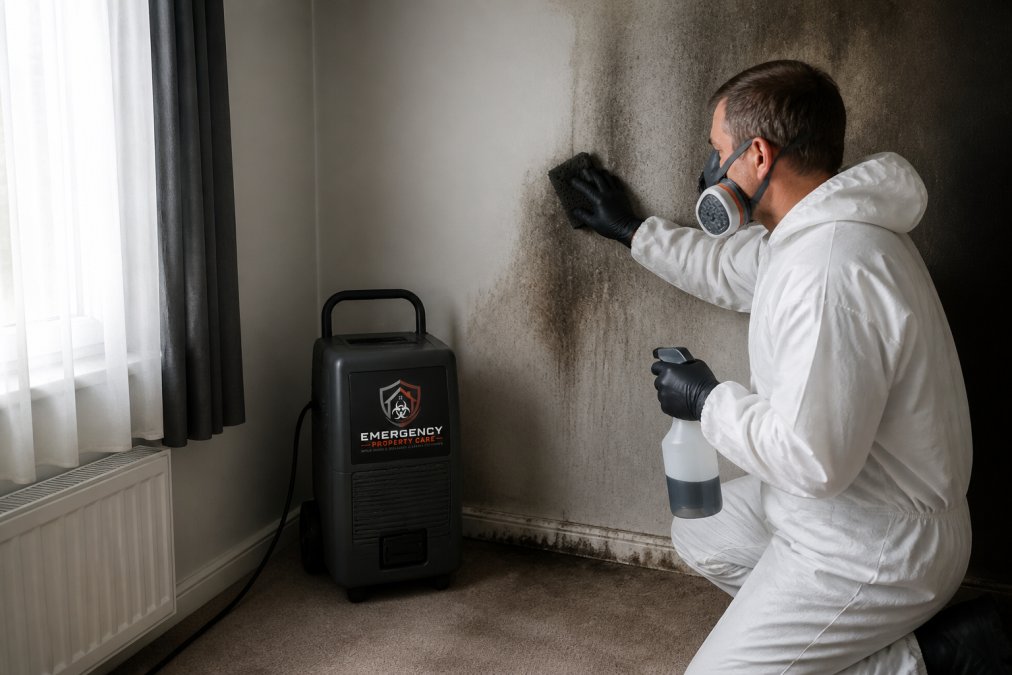
Soot and Smoke-Residue Risks
Soot is not ordinary household dust. Its composition depends on what burned, the temperature of the fire and how smoke moved through the property.
Fire residue can:
- irritate the eyes, skin and respiratory system;
- spread into rooms not directly affected by flames;
- enter cupboards, cavities and ventilation systems;
- smear or permanently mark surfaces when cleaned incorrectly;
- damage metals, finishes and electronics;
- penetrate porous furniture, textiles and building materials; and
- continue producing odour after visible staining has been removed.
Children, older occupants and people with respiratory or cardiovascular conditions may be more susceptible to exposure.
A domestic vacuum, pressure washer or unsuitable wet-cleaning method can spread or fix soot into affected materials. Obtain an assessment before disturbing widespread residue.
Read our guide to choosing professional soot-cleaning services.
Documenting Fire Damage and the Insurance Claim
Keep one physical or digital claim folder containing:
- the claim reference;
- the fire and rescue service incident reference where available;
- photographs of each affected room;
- video showing the extent of damage;
- a list of damaged belongings;
- purchase receipts or bank records where available;
- emergency accommodation and travel receipts;
- reports from structural, electrical or gas professionals;
- specialist-cleaning assessments and quotations;
- the insurer’s written approvals;
- records of materials removed from the property;
- waste-transfer or disposal documentation where applicable;
- before, during and after photographs;
- drying and moisture records; and
- the final invoice and completion information.
Photograph items before they are moved or disposed of. Where the property is unsafe, ask the appointed contractor or loss adjuster to obtain the necessary evidence.
See TrustedCare’s step-by-step fire-damage documentation guide.
The building owner normally coordinates structural cleaning and restoration, while occupants deal with their own possessions. Who ultimately pays depends on insurance cover, the cause and any proven liability.
What to Do if the Insurance Claim Is Disputed
If the insurer rejects, reduces or delays the claim:
- Ask for the decision and policy reasons in writing.
- Compare the decision with the policy wording and schedule.
- Supply any missing photographs, reports or quotations.
- Raise a formal complaint through the insurer’s complaint process.
- Keep a dated record of every communication.
- Consider appropriate professional or legal advice where liability is disputed.
- Check whether the Financial Ombudsman Service can consider the complaint after the insurer has issued its final response or the applicable complaint period has expired.
The Financial Ombudsman Service provides information about complaints involving insurance.
Do not accept a settlement without understanding whether it covers cleaning, contents, drying, repairs, professional fees and any other insured costs. Ask how the settlement was calculated and whether accepting it closes the claim.
Frequently Asked Questions
Is the landlord or tenant responsible for fire-damage cleanup?
The landlord normally coordinates structural cleaning and repairs, while the tenant deals with personal belongings and their contents insurer. A tenant may be liable where negligence or another breach is established, but responsibility depends on the tenancy, cause and insurance position.
Does home insurance cover professional fire cleaning?
Buildings and contents policies commonly cover fire, but cover depends on the policy terms, exclusions, excesses and circumstances. Report the incident promptly and obtain approval before commissioning extensive work.
Who cleans communal areas after a fire in a block of flats?
The freeholder or managing agent will commonly coordinate work affecting communal areas and the building structure through the block buildings policy. Leaseholders and tenants should report damage to their own possessions separately.
Can I choose my own fire-restoration company?
That depends on the insurer and policy. Some insurers appoint approved suppliers, while others accept quotations from a contractor chosen by the policyholder. Obtain written approval before instructing major work.
Why is specialist soot cleaning necessary?
Soot and smoke residue can spread beyond the fire room and affect porous materials, metals, finishes, electronics and concealed areas. Incorrect cleaning may spread the residue or permanently damage surfaces.
Should fire-damaged items be thrown away immediately?
Not normally. Photograph and list damaged items and ask the insurer what evidence is required before disposal. Items presenting an immediate safety risk may require urgent controlled removal, but the action should still be documented.
Nationwide 24/7 Assistance
Arrange a Fire-Damage Assessment
Contact TrustedCare for assistance with fire, smoke, soot, firefighting-water damage and property restoration across England, Scotland and Wales.
Residential, landlord, commercial and insurance-related enquiries welcome

TrustedCare Editorial Team publishes UK guidance on specialist cleaning and biohazard remediation, including after-death cleaning, flood restoration and contamination control. Content is written for homeowners, landlords and housing providers seeking clear, practical information.