Emergency Biohazard Cleanup Service Cost: What to Expect
Contents
- Typical Biohazard Cleaning Cost Bands
- What Affects Biohazard Cleanup Cost?
- What a Biohazard Cleaning Quote May Include
- The Professional Biohazard Cleaning Process
- Waste Removal and Documentation
- Biohazard Cleaning and Insurance
- How Long Does Biohazard Cleaning Take?
- Biohazard Odour Treatment
- Getting an Accurate Quote
- Frequently Asked Questions
Emergency biohazard cleanup cost depends on what happened, how far contamination has spread and which materials are affected. A small, localised incident is very different from an unattended death, multi-room contamination, sewage ingress or a property containing sharps and substantial contaminated waste.
It is rarely responsible to provide one fixed price without understanding the circumstances. Photographs and a confidential telephone assessment may provide enough information for an initial estimate, although more complex properties can require an on-site assessment.
TrustedCare can discuss the incident discreetly, establish the likely scope and explain what information is needed for an accurate quotation.
Typical Biohazard Cleaning Cost Bands
Published UK prices vary considerably because the term “biohazard cleaning” covers many different situations. As a broad guide:
| Type of work | General cost level |
|---|---|
| Small, localised contamination with limited waste | Often starts from several hundred pounds |
| Single-room specialist cleaning involving bodily fluids, affected contents or odour treatment | Frequently high hundreds into low thousands |
| Extensive decomposition, several affected rooms, substantial waste or removal of building materials | Can reach several thousand pounds or more |
| Severe hoarding containing biological contamination, pests, sharps or large quantities of waste | Requires an individual survey and detailed quotation |
These are broad market indications, not a TrustedCare quotation. The final price can only be determined from the actual work required. For further background, see the UKBiohazardBlog guide to after-death cleaning costs.
What Affects Biohazard Cleanup Cost?
Type of incident
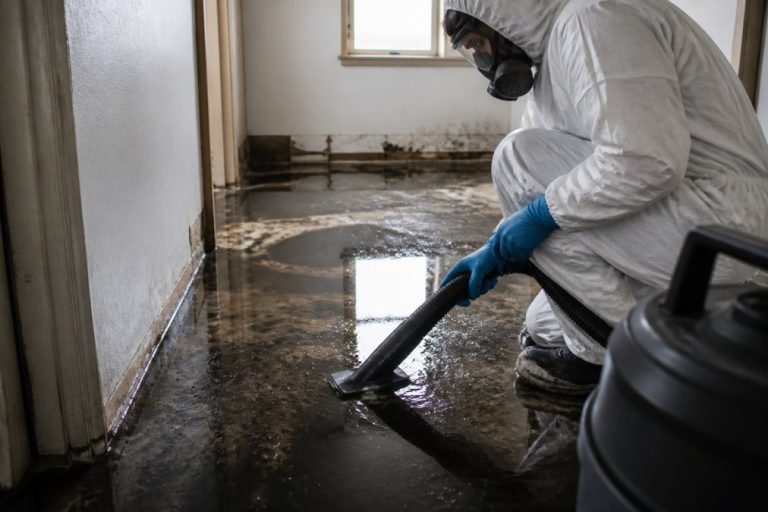
Different incidents require different controls and working methods. Examples include blood and bodily-fluid contamination, an unattended death, sewage, discarded needles, animal waste, trauma scenes and hoarded properties containing biological hazards.
The presence of a particular contaminant does not automatically determine the entire price. The affected surface, amount present, length of exposure and potential for hidden spread also matter.
Size of the affected area
A small area on a sealed surface may require limited work. Contamination that has entered carpets, underlay, floorboards, wall cavities, furniture or several rooms can require substantially more labour and material removal.
Porous and absorbent materials
Sealed, non-porous surfaces may be capable of being cleaned and treated. Heavily affected mattresses, carpets, underlay, soft furnishings and other absorbent materials may be more difficult to clean reliably.
Not every item automatically needs to be discarded. Decisions should be based on the material, contamination, exposure time and whether the item can be cleaned safely.
Waste volume and classification
The amount and type of waste affect the containers, transport, paperwork and disposal route required. Waste must be correctly assessed and transferred to an appropriately authorised person or facility.
Not everything removed during a biohazard clean is automatically classified as hazardous waste. The contractor must determine the correct classification and handle it accordingly.
Access and property layout
Stairs, restricted parking, top-floor flats, narrow entrances, remote locations and heavily cluttered rooms can increase the time required to move equipment and waste safely.
Additional hazards
Sharps, unstable flooring, pest activity, damaged electrical systems, asbestos-containing materials or substantial structural damage may require additional controls or another qualified contractor.
Urgency and attendance
Urgent or out-of-hours attendance, where available, may affect the price. TrustedCare does not advertise a universal 24/7 arrival promise. Availability and any additional attendance charge should be confirmed before work is authorised.
A quotation should clearly state whether it is fixed or estimated and explain which circumstances could change the final price.
What a Biohazard Cleaning Quote May Include
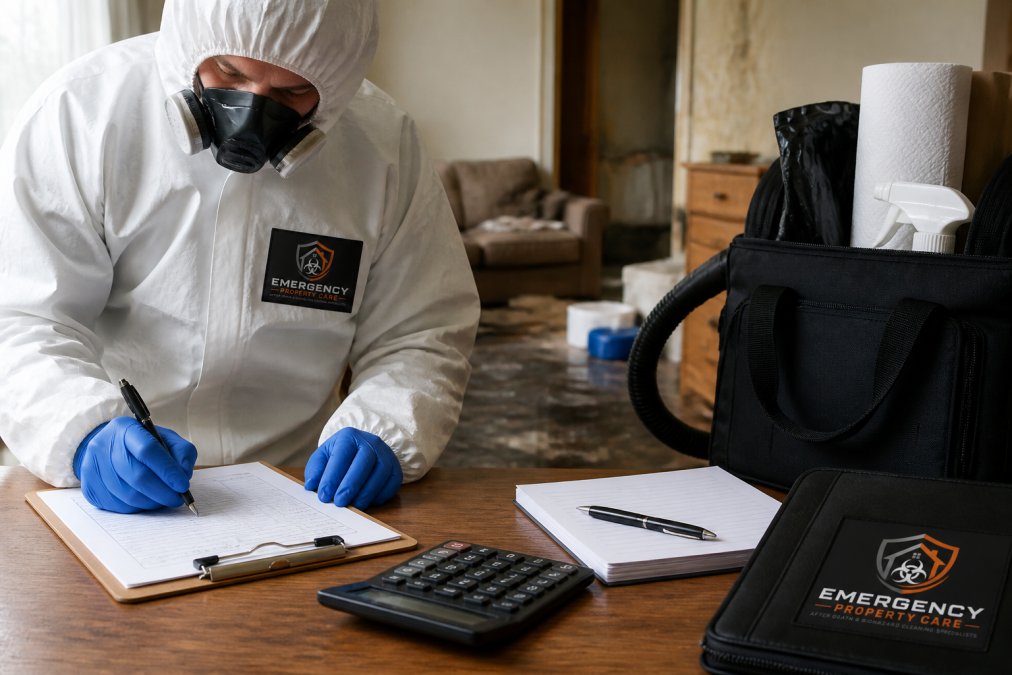
A complete quotation should describe the agreed work rather than provide only a total price. Depending on the incident, it may include:
- Initial assessment and risk planning
- Labour and estimated number of technicians
- Personal protective equipment
- Area isolation or contamination-control materials
- Removal of visible biological material
- Cleaning and decontamination of suitable surfaces
- Removal of specified carpets, underlay, furniture or other affected materials
- Appropriate waste containers and disposal charges
- Odour-source treatment
- Travel, parking or access charges
- Equipment required for the agreed work
- Any available completion or waste documentation
- VAT, where applicable
Ask whether contents removal, flooring removal, waste disposal and odour treatment are included. These are common reasons why an initial estimate may differ from the final invoice.
The Professional Biohazard Cleaning Process
Initial assessment
The first stage is to establish what happened, which rooms and materials are affected, whether the source remains present and whether there are additional hazards such as sharps or damaged flooring.
Information may initially be gathered by telephone and photographs. Complex incidents or properties with uncertain contamination can require an on-site assessment before a fixed quotation is possible.
Contamination controls
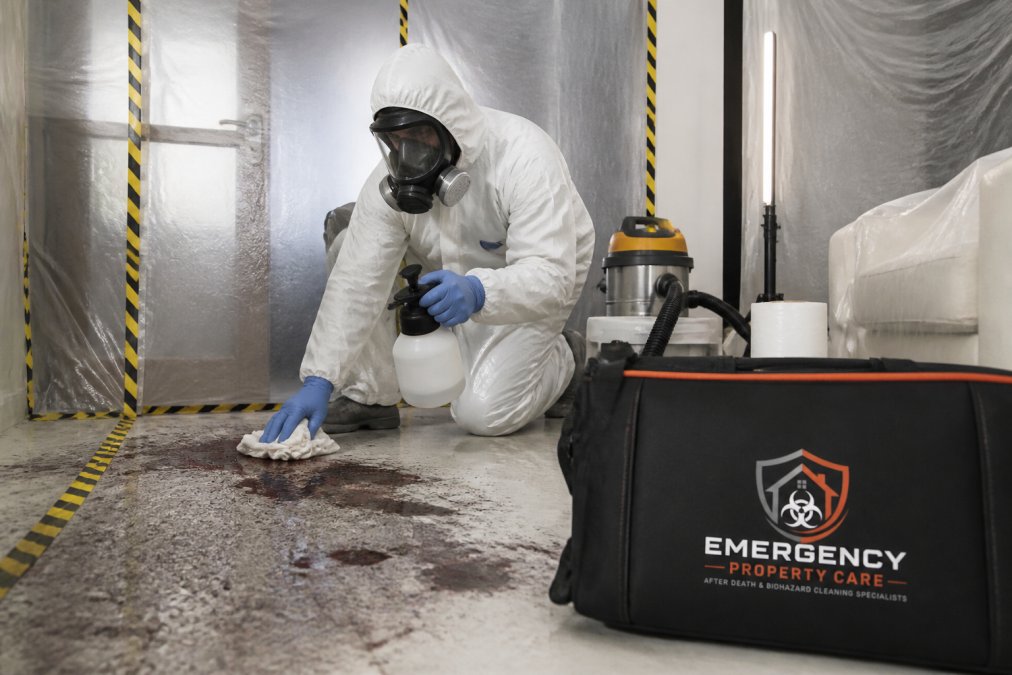
Access to affected areas may be restricted to prevent contamination being carried into clean rooms. The necessary controls depend on the property layout, type of incident and likelihood of splashing, sharps injuries or other exposure.
Removal of biological material
Visible biological material is carefully removed before the underlying surfaces are cleaned. Starting with disinfectant alone can leave contamination beneath the treated surface, so cleaning and decontamination must follow an appropriate sequence.
Cleaning and decontamination
Products should be selected for the surface and type of contamination and used according to their instructions, including the required concentration and contact time. HSE guidance states that blood and bodily-fluid spillages should be made safe promptly while protecting workers from exposure.
Assessment of contents and building materials
Items that can be cleaned safely may be retained. Materials that cannot be reliably cleaned, or which contain contamination that has penetrated beyond accessible surfaces, may require removal.
Final review
The cleaned area should be reviewed against the agreed scope. Any remaining repair, replacement, drying or reinstatement requirements should be explained to the customer.
Waste Removal and Documentation
Businesses producing, carrying or controlling waste have legal responsibilities. Waste must be classified correctly, stored safely and transferred only to an appropriately authorised person or facility.
Where hazardous waste is transported, additional requirements can apply, including registration, consignment notes and record keeping. The exact documentation depends on the waste classification and the part of the UK where the work takes place.
Customers can ask the contractor:
- Whether waste removal is included in the quotation
- How the waste will be classified
- Who will transport it
- Where it will be taken
- What transfer or consignment paperwork will be supplied
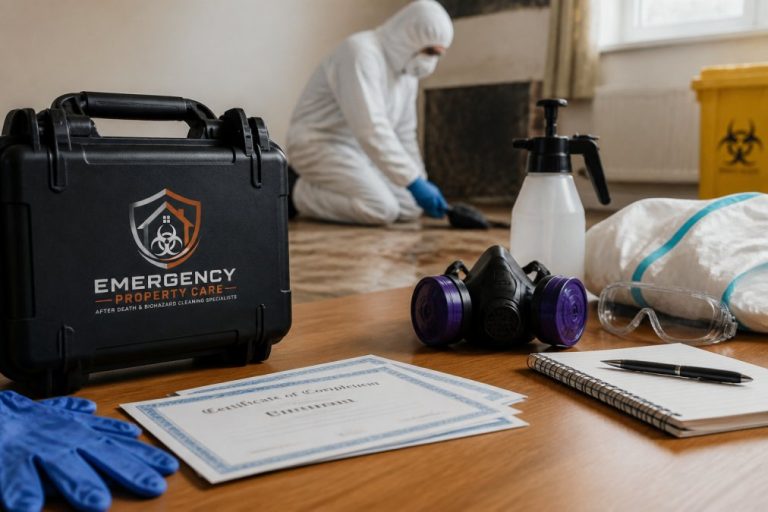
Some cleaning companies provide a completion report or their own cleaning certificate. However, there is no single universal “Certificate of Sanitisation” that UK law requires after every domestic biohazard cleaning job.
If a report or certificate is offered, ask what it confirms, which areas it covers and whether any sampling or testing was actually undertaken. A certificate should not make broader claims than the work completed can support.
Biohazard Cleaning and Insurance
Insurance coverage varies according to the policy, type of incident and cause of the damage. It is inaccurate to state that most policies either automatically cover or automatically exclude biohazard cleaning.
Contact the insurer as soon as reasonably possible and ask:
- Whether the incident may be covered
- Whether emergency cleaning can begin immediately
- Whether photographs or an inspection are required
- Whether the insurer wants to appoint a loss adjuster
- Whether it requires quotations or an approved contractor
- Which documents should be retained
Do not delay urgent action needed to protect people or prevent contamination from spreading. Where possible, photograph the affected areas before materials are removed and keep an itemised record of discarded contents.
TrustedCare cannot guarantee that an insurance claim will be accepted or state how long an insurer will take to process it.
How Long Does Biohazard Cleaning Take?
There is no universal completion time. A small incident confined to a cleanable surface may require several hours, while an unattended death, multi-room contamination or severe hoarding environment may require several visits.
The programme can be affected by:
- The area and materials involved
- The amount of contaminated waste
- How long contamination has been present
- Property access
- Whether flooring or other materials must be removed
- Additional pest, odour or moisture problems
- The time required to arrange an appropriate waste collection
Attendance time and completion time are separate. TrustedCare will confirm current availability after the incident details and property postcode have been reviewed.
Biohazard Odour Treatment
Persistent odour can indicate that the original source remains present or that contamination has entered an absorbent material or concealed area. Fragrance and surface spraying may temporarily cover an odour but will not remove its source.
Effective odour treatment normally begins with:
- Locating and removing the source where possible
- Cleaning affected surfaces and materials
- Assessing flooring, furniture and concealed spaces
- Removing materials that cannot be cleaned reliably
- Selecting an appropriate additional odour treatment if required
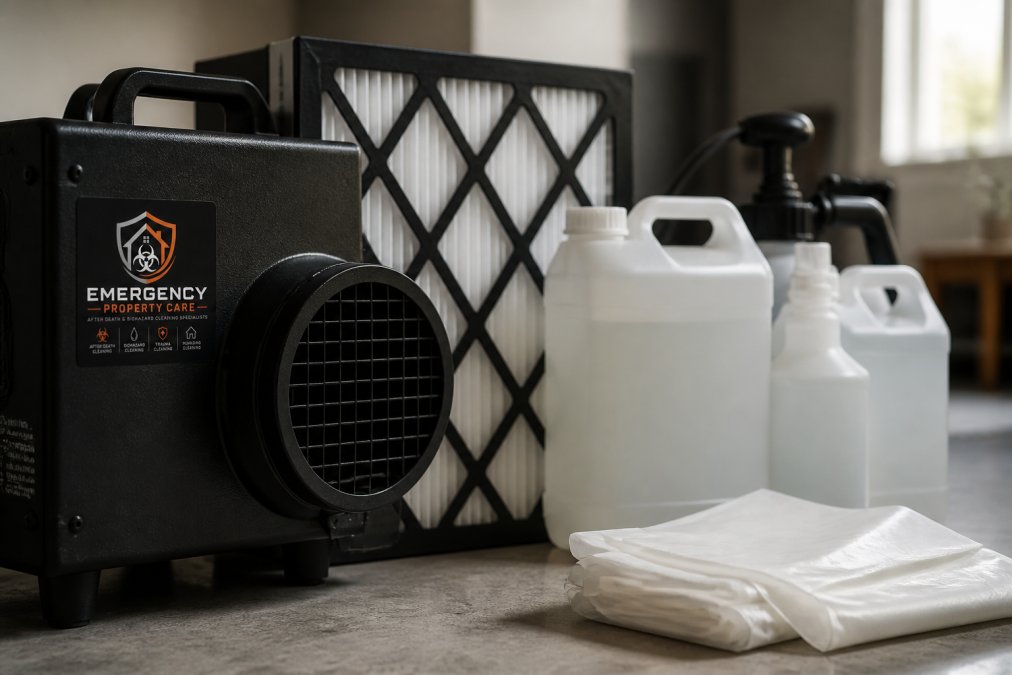
No single machine or chemical is suitable for every situation. HEPA filtration, air treatment equipment and specialist odour-control products may be useful in some circumstances but are not automatically required for every biohazard clean.
Getting an Accurate Biohazard Cleaning Quote
When requesting a quotation, provide as much information as you comfortably can. Useful details include:
- The property postcode
- Type of incident
- Number of rooms affected
- Flooring and other materials involved
- How long the contamination may have been present
- Whether strong odours, insects or sharps are present
- Access, parking and floor level
- Whether contents or flooring may require removal
- Whether the insurer has given any instructions
Photographs can help with an initial assessment, although images do not always show contamination beneath flooring or inside furniture.
A useful quotation should explain:
- The proposed scope of work
- What will be cleaned, removed or disposed of
- Whether the price is fixed or estimated
- Potential additional charges
- What documentation will be provided
- When the work could begin
TrustedCare handles sensitive enquiries discreetly. You do not need to include distressing details in an online form if you would prefer to discuss them directly.
Frequently Asked Questions
What has the biggest effect on biohazard cleaning cost?
The main factors are the type and extent of contamination, materials affected, number of rooms, waste volume and property access. Hidden contamination or the need to remove flooring and contents can significantly affect the final price.
Can I receive a biohazard cleaning quote from photographs?
Sometimes. Clear photographs and an accurate description may allow an initial estimate or fixed quote for straightforward work. Complex incidents, uncertain contamination or heavily cluttered properties may require an on-site assessment.
Does insurance cover biohazard cleaning?
It depends on the policy and cause of the incident. Contact the insurer for a decision about the individual claim. Do not assume that the work is automatically covered or excluded.
Does TrustedCare offer guaranteed emergency attendance?
No universal attendance time is advertised. Availability depends on the postcode, type of incident, access and resources required. Contact TrustedCare so the circumstances and current availability can be checked.
Is a Certificate of Sanitisation legally required?
There is no single universal certificate legally required after every domestic biohazard clean. Contractors may provide their own completion reports or certificates. Ask what the document confirms and whether any specific inspection or testing supports it.
How long does biohazard cleanup take?
Small, contained incidents may be completed in several hours. More extensive contamination, unattended deaths and hoarding environments can require several visits. A reliable timeframe can only be provided after the scope is understood.
Can I clean a biohazard incident myself?
A minor spill on a cleanable surface is different from extensive blood, decomposition, sewage, sharps or contamination of absorbent materials. Professional help should be considered where there is a risk of exposure, hidden contamination or controlled waste requiring specialist handling.
Request a Confidential Biohazard Cleaning Quote
Contact TrustedCare with the property postcode, type of incident and areas affected. We will discuss the situation discreetly, explain the information required and provide or arrange an appropriate quotation without unsupported promises about attendance, insurance or certification.
Official Guidance
- Health and Safety Executive: Decontamination of blood and bodily-fluid spills
- GOV.UK: Waste duty of care code of practice
- GOV.UK: Waste classification responsibilities

TrustedCare Editorial Team publishes UK guidance on specialist cleaning and biohazard remediation, including after-death cleaning, flood restoration and contamination control. Content is written for homeowners, landlords and housing providers seeking clear, practical information.