Emergency Decontamination Training for Residential Staff
Table of Contents
- Why Residential Staff Need Emergency Decontamination Training
- Risk Assessment for Residential Biohazard Incidents
- PPE Requirements for Biohazard Cleaning: What Staff Must Know
- Staff Training Duration for Decontamination: How Long Is Enough?
- The Five Stages of Decontamination in a Residential Setting
- Legal Duties and Compliance for Residential Building Managers
- When to Bring in a Specialist Decontamination Team
- Frequently Asked Questions
Last Updated: September 28, 2026
Why Residential Staff Need Emergency Decontamination Training
Emergency decontamination training gives residential building staff the skills to protect themselves, contain a hazard and call for the right help. It is not about turning caretakers into hazmat technicians. It is about the first ten minutes.
Decontamination training covers three things:
- How to spot a biological or chemical hazard
- How to protect yourself with the right PPE
- How to isolate the area and escalate
The goal of staff training is containment and safe withdrawal, not full clean-up. Untrained staff who “have a go” usually spread contamination into stairwells, lifts and communal areas.
Risk Assessment for Residential Biohazard Incidents
A risk assessment for residential biohazard incidents is a written record of what the hazard is, who could be exposed and what controls are needed. It should exist before an incident, not during one.
Identifying Hazards Before Anyone Enters
Staff should treat any unknown spill, odour or fluid as potentially infectious. Look for these signs:
- Strong, persistent odour in a closed flat
- Visible fluids, staining or fly activity
- Discarded needles or drug paraphernalia
- Sewage backing up into a ground-floor flat
Never enter alone. Never touch fluids with bare hands.
When to Escalate to a Specialist Contractor
Escalate immediately if the incident involves decomposition, sewage, blood, or any unknown chemical. These are not routine cleaning jobs.
PPE Requirements for Biohazard Cleaning: What Staff Must Know
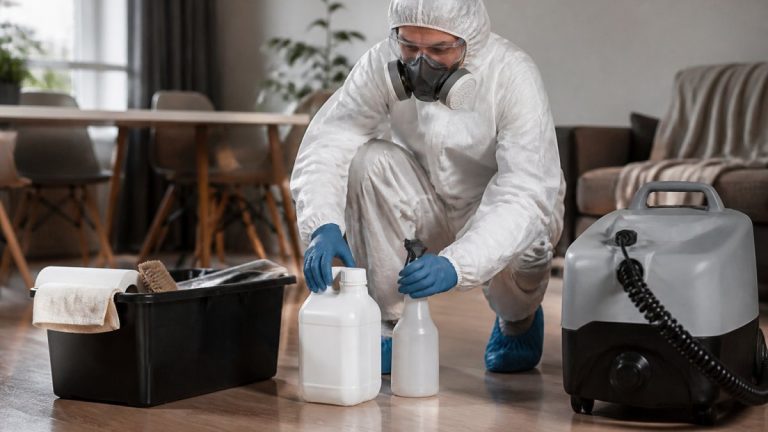
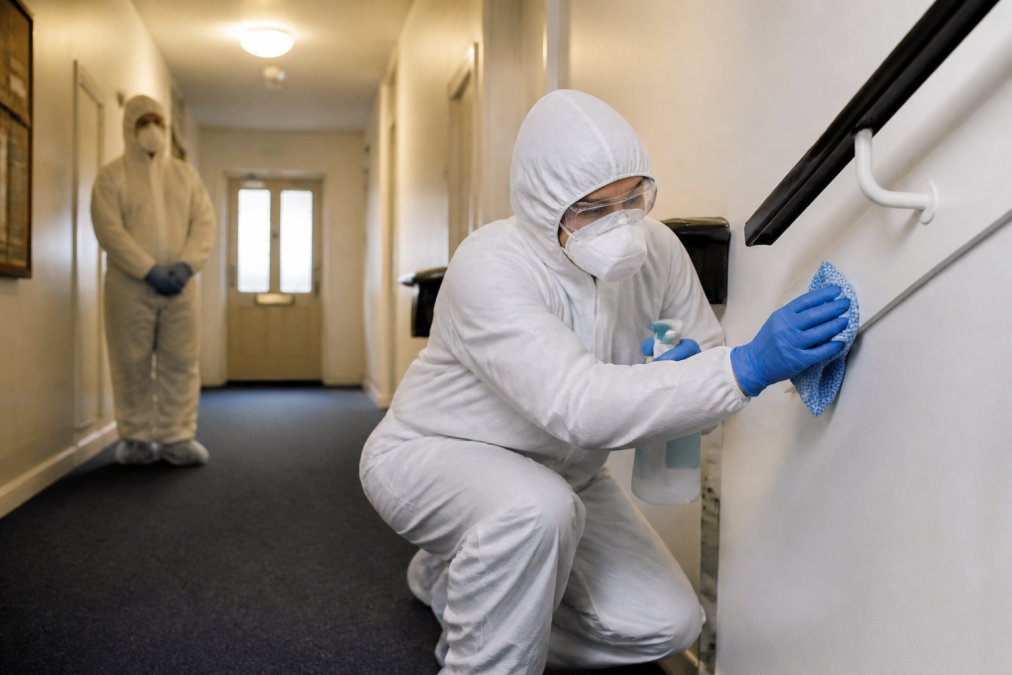
PPE requirements for biohazard cleaning in a residential building start with disposable coveralls, nitrile gloves, eye protection and a fitted respiratory mask. Staff should also wear shoe covers and use heavy-duty waste bags. The kit must be stored together, checked monthly and replaced when damaged.
The Difference Between Splash and Airborne Protection
Most residential incidents fall into one of two categories, and the PPE is not the same for both.
- Splash risk, blood, sewage, floodwater, visible fluids. Coveralls, nitrile gloves, eye protection and shoe covers are the priority. An FFP3 mask is still sensible but the main threat is contact.
- Airborne risk, decomposition odour, unknown chemical vapour, aerosolised sewage. A fitted FFP3 mask (or higher, if advised) becomes the primary control, because coveralls alone will not stop inhalation.
| PPE Item | Purpose | Disposal |
|---|---|---|
| Disposable coveralls | Stops fluid contact | Double-bag after use |
| Nitrile gloves | Hand protection | Replace if torn |
| FFP3 mask | Filters airborne particles | Single use only |
| Eye protection | Splash guard | Wipe or discard |
| Shoe covers | Stops floor transfer | Bag and bin |
Do not reuse any item that touches contamination.
Donning and Doffing in a Communal Building
In a hospital, PPE is donned and doffed in a controlled anteroom. In a residential block, staff often have a lift lobby, a service corridor or a stairwell landing, and residents walking past.
The practical sequence most practitioners follow:
- Don before entering the affected zone, not at the flat door. Use a clean staging point such as a service cupboard or the far end of a corridor.
- Work from clean to dirty. Gloves go on last, over the coverall cuffs.
- Doff in reverse, slowly. Remove gloves first, then coverall, then eye protection, then mask last. Every removal step is a contamination risk.
- Bag as you go. Each item goes straight into a double bag at the staging point, never carried through the building.
- Wash hands immediately after doffing, even if gloves stayed intact.
Storage in a Residential Setting
PPE stored in a damp basement or a hot plant room degrades. A sealed, labelled cupboard away from communal traffic is the usual solution. The kit should be checked monthly, and any item past its marked expiry or with a damaged seal should be replaced before the next incident.
Storing PPE but never practising with it is a common failure. Staff who have never donned a mask under time pressure will get it wrong during a real incident, and a badly fitted mask gives false confidence.
::: Rigorous decontamination protocols must extend beyond emergency gear to include consistent environmental hygiene, as preventing staff illness relies as much on the cleanliness of the facility as it does on the integrity of individual protective equipment.
What Staff Should Not Do
PPE is a last line of defence, not a licence to enter. Staff should not:
- Enter a flat alone, whatever PPE they are wearing
- Attempt to move a body or clean decomposition without specialist assessment
- Reuse gloves, masks or coveralls between rooms
- Take PPE home for washing
Staff Training Duration for Decontamination: How Long Is Enough?
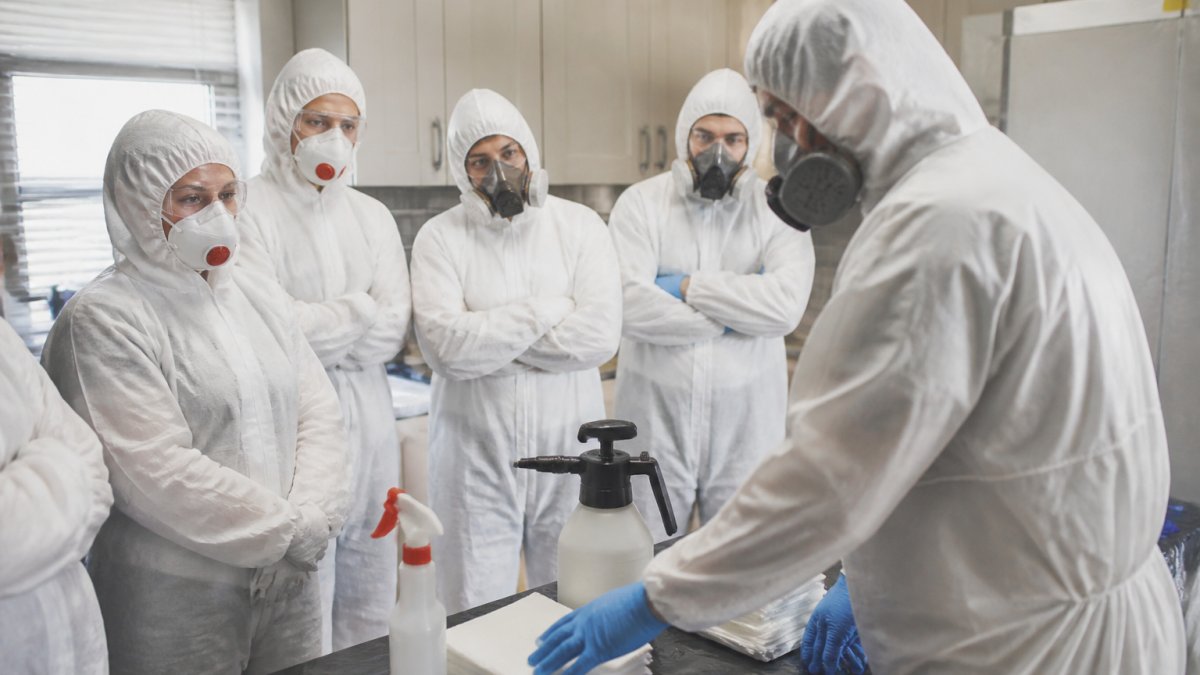
Staff training duration for decontamination depends on the role. Front-line staff need a short induction. Supervisors need a longer session with practical drills.
A practical split:
- All staff: a short awareness session covering hazard spotting and escalation
- Supervisors: a half-day session with PPE fitting and containment drills
- Refreshers: annually, plus after any real incident
The Five Stages of Decontamination in a Residential Setting
The five stages of decontamination are: scene assessment, containment, primary decontamination, secondary decontamination and waste disposal. Each stage must be completed before the next begins. In a residential block, this usually happens in a communal hallway, a lift lobby or a service corridor, space is tight, residents are nearby, and the plan has to account for both.
Stage 1, Scene Assessment
Before anyone enters, staff establish what the hazard is, who is at risk and whether the area can be safely isolated. This is a look-and-report stage, not a clean-up stage. If the hazard is unknown, the assessment ends with a call to a specialist.
Stage 2, Containment
Containment means stopping the hazard spreading beyond the flat. In practice this means:
- Closing the flat door and sealing the gap if safe to do so
- Switching off any shared ventilation that serves the affected flat, if that can be done without entering
- Cordononing the corridor, lift lobby or stairwell landing with tape
- Diverting residents away from the affected route, including any lift that opens onto it
Stage 3, Primary Decontamination
Primary decontamination removes the bulk of contamination from people and surfaces at the scene. For people who may have been exposed, this means removing outer clothing, bagging it and washing exposed skin with soap and water where safe to do so. For surfaces, it means removing visible contamination before any deeper clean.
Stage 4, Secondary Decontamination
Secondary decontamination is the deeper clean of equipment, PPE and the surrounding area, often at a controlled point away from residents. In a residential block, this is usually handled by the specialist team rather than building staff, because it requires testing, appropriate chemicals and a controlled waste route.
Stage 5, Waste Disposal
Contaminated waste from a residential decontamination is not general refuse. Coveralls, gloves, masks, cleaning cloths and any removed materials are usually classified as hazardous or clinical waste and must go through a licensed disposal route. Putting them in the building’s communal bin is a common and serious error, it exposes refuse collectors, residents and anyone using the bin store.
Tenant Communication: The Step Most Guides Skip
Most decontamination guides are written for hospitals or industrial sites. They assume the building can be cleared. A residential block cannot.
- Which area is closed and for how long (as an estimate, pending assessment)
- Which route to use instead
- Who to contact with concerns
- That the situation is being managed and there is no need to enter the affected area
DIY or Specialist? The Threshold
A useful rule of thumb for building staff:
- Staff can handle a small, known spill of a non-infectious substance with the correct PPE and a clear exit route.
- Staff should evacuate and call a specialist for anything involving decomposition, sewage, blood, unknown substances, a body, or any incident where the hazard cannot be identified from a safe distance.
The cost of a specialist assessment is almost always lower than the cost of a spread contamination problem, and the legal duty to protect staff and residents sits with the building’s duty holder either way.
Legal Duties and Compliance for Residential Building Managers
Building managers have clear legal duties under UK health and safety law. The Health and Safety at Work etc. Act 1974 sets the framework. The Management of Health and Safety at Work Regulations require suitable risk assessments.
Key duties include:
- Assessing risks to staff, residents and visitors
- Providing suitable PPE at no cost to staff
- Recording incidents and near-misses
- Training staff for their actual role
When to Bring in a Specialist Decontamination Team
Bring in a specialist team the moment an incident involves decomposition, sewage, blood or an unknown substance. Do not wait to see if it “cleans up fine”.
Frequently Asked Questions
What are the core components of emergency decontamination training for residential staff?
Core components include hazard identification, risk assessment, correct donning and doffing of PPE, the five stages of decontamination, safe containment of a contaminated area, and knowing when to escalate to a specialist contractor. Training should also cover COSHH awareness, waste disposal procedures and the limits of what untrained staff can safely handle. Practical scenario exercises reinforce these elements far better than classroom theory alone.
How often should residential property staff undergo decontamination refresher training?
Annual refresher training is the practical minimum for most residential settings. Staff who handle biohazard incidents frequently may benefit from six-monthly updates. Refreshers should be triggered sooner if regulations change, new equipment is introduced, or an incident reveals gaps in knowledge. Scenario-based exercises at least once a year help keep skills current and build confidence under pressure.
What is the difference between primary and secondary decontamination in a residential setting?
Primary decontamination happens immediately at the scene to remove the bulk of contaminants from people and surfaces. Secondary decontamination is a more thorough process carried out in a controlled area, often after the initial response. In residential buildings, primary decontamination may involve removing contaminated clothing and rinsing exposed skin, while secondary decontamination covers full cleaning of the affected space and safe disposal of waste.
When should residential building managers call a professional decontamination team instead of handling it in-house?
Call a specialist when the contamination involves biological fluids, decomposition, sewage or unknown hazardous materials. Untrained staff should not attempt cleanup of these incidents because of infection risk and the potential for spreading contamination. A professional team has the equipment, PPE and disposal arrangements to handle the situation safely. TrustedCare offers 24/7 emergency response across England, Scotland and Wales for these situations.

TrustedCare Editorial Team publishes UK guidance on specialist cleaning and biohazard remediation, including after-death cleaning, flood restoration and contamination control. Content is written for homeowners, landlords and housing providers seeking clear, practical information.